End uses and safety — fuel cells / combustion / NOx / leaks
Separate fuel cells from combustion use, and organize the pillars of safety design: NOx, flame detection, ventilation, leak detection, and life-cycle assessment.
This chapter is split in two: the first half compares end-use modes (fuel cell vs. combustion), and the second half covers safety design specific to hydrogen. Section dividers below mark the switch.
Part 1: Comparing end-use modes
"How it is used" changes its character
Even for the same H₂, the character of the equipment and the exhaust issues are different depending on whether it is used in a fuel cell or burned in an engine or turbine. A fuel cell converts chemical energy directly into electricity, so for the same amount of hydrogen it tends to be favorable on efficiency; for mobility, PEM fuel cells (Proton Exchange Membrane, also called polymer-electrolyte fuel cells) are the common choice to discuss. PEM uses a thin ion-exchange membrane as the electrolyte and operates at relatively low temperatures around 80 °C, which makes it easy to start and stop and well suited for on-board and small stationary systems.
Hydrogen engines and hydrogen turbines, on the other hand, are easier to couple with existing combustion technologies and high-temperature heat, but because they involve combustion, NOx control can become necessary depending on conditions. Here too, the point is not "hydrogen is all the same"; it is to split the picture by end-use mode.
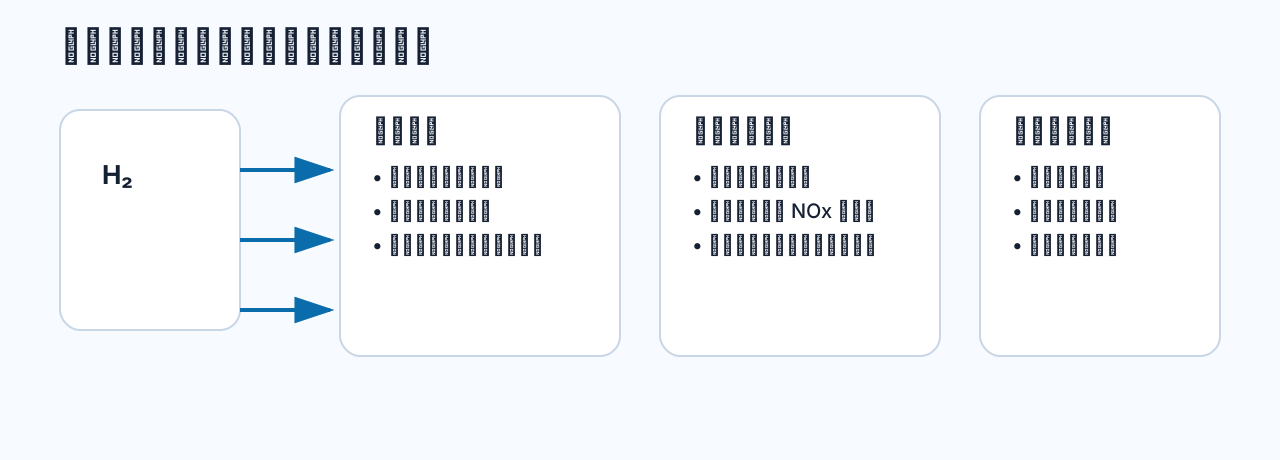
Fuel cells are electrochemical; engines and turbines are combustion. Efficiency, exhaust, and operation all change.
NOx is a "nitrogen story", not a "carbon story"
Because hydrogen itself contains no carbon, in principle no CO₂, CO, or particulate matter (PM) is emitted when it is burned. However, atmospheric nitrogen (N₂) and oxygen (O₂) can combine at high temperatures to form NOx (nitrogen oxides). NOx is classified by formation mechanism as follows.
- Thermal NOx: formed in hot combustion gas when N₂ and O₂ react. It rises sharply once flame temperatures exceed roughly 1500 °C. This is the type that matters most in practical hydrogen combustion.
- Prompt NOx: formed in the fuel-rich region of the flame front when hydrocarbon radicals react with N₂. Hydrogen combustion produces no hydrocarbon radicals, so this type does not occur in principle.
- Fuel NOx: formed from nitrogen contained in the fuel itself. With pure hydrogen as the fuel, this is zero in principle.
So the heart of NOx control in hydrogen combustion is narrowed down to techniques that lower the flame temperature — lean combustion, exhaust gas recirculation, dilution, staged combustion, and the like. None of this applies to fuel cells.
Part 2: Hydrogen-specific safety design
Safety: not "a high-risk fuel" by default, but "design matched to the properties"
Hydrogen is significantly lighter than air, so a leak tends to disperse upward. At the same time, it has a wide flammability range in air and is easy to ignite. The flame is also hard to see, so flame detection, sensors, ventilation, pressure relief, material selection, and training all matter.
The point is simple: because hydrogen has properties different from gasoline, it needs different design considerations. Rather than treating hydrogen as excessively dangerous or dismissing the risks, treat it as engineering design matched to the properties.
Practice 1–3 — Fuel cells vs. combustion use
Check the difference between fuel cells and combustion use, and the topics of NOx and flame detection.
Q1. Which is the closest description of a fuel cell?
A fuel cell extracts electricity through an electrochemical reaction, not combustion.
A fuel cell is an end-use mode that converts the chemical energy of hydrogen directly into electricity, and for the same amount of hydrogen it tends to be favorable on efficiency.
Q2. Which is the closest reason why NOx becomes a topic for engines and turbines that burn hydrogen?
Focus on the nitrogen in the air, not carbon.
Hydrogen itself contains no carbon, but in combustion, high-temperature conditions can still produce NOx from atmospheric nitrogen.
Q3. Which is the closest reason why special detection care is required for hydrogen flames?
The point was that visual cues alone are not enough.
Because hydrogen flames are hard to see, dedicated flame detection and sensor design become important.
Practice 4–5 — Ventilation and life-cycle viewpoint
Check ventilation and leak detection, and why the use point alone is not enough.
Q4. Which is the closest reason why ventilation and leak detection matter in hydrogen facilities?
This is design to keep flammable mixtures from building up in enclosed spaces.
Ventilation and leak detection are basic safety-design elements for avoiding the accumulation of flammable mixtures.
Q5. Which of the following statements is incorrect?
Recall this course's repeated emphasis on 'look upstream.'
How things look at the point of use is not enough. You need to evaluate including production, compression/liquefaction, transport, and leakage losses.
Key takeaways from Chapter 5
- Fuel cells extract electricity electrochemically; because hydrogen engines and turbines involve combustion, NOx control is needed.
- Hydrogen flames are hard to see, so pair the design with dedicated flame detection, ventilation, and leak detection.
- Even if only water is visible at the point of use, evaluate with a life-cycle view that includes production, storage, and transport.