Understand Hydrogen as a Fuel with Diagrams and Exercises
An introductory course that covers lightness, volumetric energy density, production routes, storage and transport, fuel cells and combustion, and safety, connecting them through diagrams and 36 short exercises.
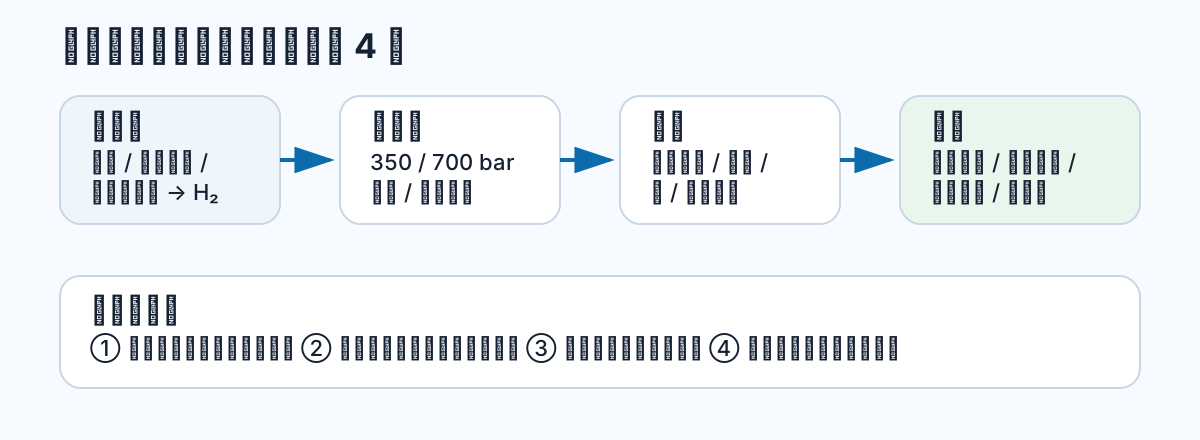
First, read hydrogen as a fuel through the flow "make → store → transport → use".
The first intuition we want to build in this course
The important thing when understanding hydrogen as a fuel is not to decide "hydrogen is clean or not" from a single word. You need to read it as one system: where H₂ is produced, how it is stored, in what form it is transported, whether it is used in a fuel cell or in combustion, and how safety is designed in.
In this course we start from the property that hydrogen is strong on a mass basis but disadvantaged on a volume basis, and connect SMR, water electrolysis, carbon intensity, 350/700 bar, liquid, carriers, fuel cells, hydrogen engines, and safety design with diagrams and short exercises.
Five viewpoints we keep reusing in this course
These "five viewpoints" run through the "three issues (feedstock and production / logistics and storage / end-use mode)" and the "four boxes (make → store → transport → use)" introduced in Chapter 1, as well as the "six knobs (hydrogen amount, upstream carbon intensity, storage mode, end-use mode, handling loss, and safety design level)" of Chapter 6. Roughly: "make" in the four boxes = "feedstock and production" of the three issues = viewpoint 3 (route and carbon intensity). "Store + transport" = "logistics and storage" = viewpoint 2 (mass vs volume) and the first half of viewpoint 4. "Use" = "end-use mode" = the second half of viewpoint 4 plus viewpoint 5. Viewpoint 1 (energy carrier) is the premise that runs through all four boxes. The six knobs in Chapter 6 are the simulator-side inputs derived from each box and viewpoint.
Chapter overview
Tips for studying
- First, do not mix up "mass" and "volume". This is the most important thing.
- Next, separate "the place of use" from "upstream". Looking only at the tailpipe does not tell you the whole story.
- Finally, do not mix up "fuel cell" and "combustion". Efficiency, exhaust, and equipment all change.
Prerequisites
- Familiarity with high-school-level chemistry and the entry points to energy — the words molecule, reaction, and heat value — is enough.
- We do not go into rigorous thermodynamics, compressor design, or clause-by-clause reading of standards. The priority is first to grasp the big picture and the trade-offs.
- The simulator is a conceptual educational model and does not represent guaranteed equipment specifications or code-mandated design values.
References consulted
- DOE: Hydrogen and Fuel Cell Technology Basics
- DOE: Hydrogen Fuel Basics
- DOE: Hydrogen Storage
- DOE: Safe Use of Hydrogen
- DOE: Fuel Cell Basics
- AFDC: Hydrogen Basics
- AFDC: Hydrogen Production and Distribution
- AFDC: Fuel Properties Comparison
- AFDC: Fuel Cell Electric Vehicles
- IEA: Global Hydrogen Review 2025 (Executive Summary)
- METI: Basic Hydrogen Strategy (Japan)