Introduction — why use hydrogen as a fuel
Treat hydrogen not as a fuel you dig up but as an energy carrier you make and deliver, and build the big picture with the four boxes of production, storage, transport, and use first.
Hydrogen is not a "fuel you dig up" but a "fuel you make and deliver"
Rather than a fuel you simply extract in bulk from the ground, hydrogen is an energy carrier that you produce from electricity, fossil fuels, biomass, or other sources, and then move to where you need it. The contrast to keep in mind is with primary energy — oil, coal, natural gas, uranium, solar, wind, hydro, and so on, the energy obtained directly from nature. Hydrogen is positioned as a secondary medium that is produced from those and then delivered. The important thing is not to look at hydrogen in isolation, but to capture "where it was made", "how it was stored", and "what it was used for" as a single flow.
In this course, we first build the big picture with four boxes: make → store → transport → use. The goal is not just to memorize the molecular formula, but to be able to read the entire value chain.
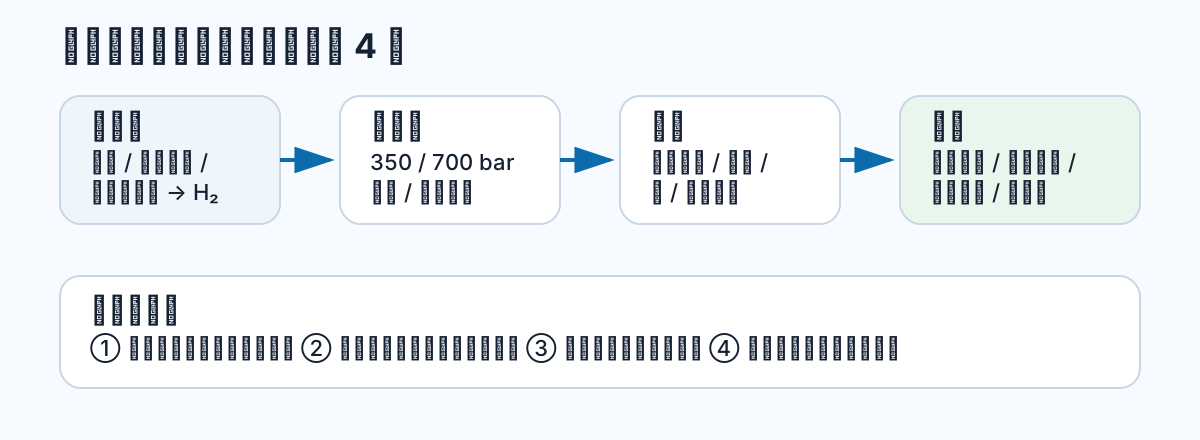
First, read hydrogen as a fuel through the four boxes "make → store → transport → use".
Why it draws attention
There is not just one reason hydrogen draws attention. If you use it in a fuel cell, at the point of use you can obtain electricity with water and heat as the main byproducts, and you can also view it as a way to convert surplus electricity into chemical energy for use later. In addition, hydrogen becomes a viable option for applications where electrification alone struggles to deliver: long operating hours, quick refueling, and connection to existing high-temperature heat demand.
That said, just because hydrogen emits only water at the point of use does not automatically mean the whole system is low-carbon. The overall evaluation is only settled once you also consider which electricity was used for electrolysis, how much CO₂ was captured from reforming, and how much energy was consumed in liquefaction and transport.
Three issues to separate first
- Feedstock and production (= "make" in the four boxes): natural-gas reforming, water electrolysis, or biomass. Covered in Chapter 3.
- Logistics and storage (= "store + transport"): 350/700 bar compression, liquefaction, or loading onto a carrier. Covered in Chapter 2 (properties) and Chapter 4 (modes).
- End-use mode (= "use"): converting to electricity in a fuel cell, or burning it in an engine or turbine. Covered in Chapter 5.
If you mix these three together when talking about hydrogen, the discussion quickly becomes vague. In this course we separate the issues chapter by chapter, and bring them back into one picture at the end. The three issues are essentially the four boxes viewed from a practitioner's angle — the same thing seen from a different side.
Practice 1–3 — Positioning and the big picture
Check the positioning of hydrogen, how it looks at the point of use, and the four-box big picture.
Q1. Which of the following best describes hydrogen?
Think in terms of whether 'where it was produced' matters for this fuel.
Hydrogen is an energy carrier. You produce it from other energy sources such as electricity or fossil fuels, and then move it to where it is needed.
Q2. When hydrogen is used in a fuel cell, which of the following is closest to what is obtained directly at the point of use?
Fuel cells extract electricity via an electrochemical reaction, not combustion.
When hydrogen is used in a fuel cell, electricity, water, and heat are primarily obtained. You need to separate what is visible at the point of use from the carbon intensity of the supply side.
Q3. Which sequence is the one we reuse throughout this course as the first way to organize hydrogen as a fuel?
We split the whole value chain into four parts.
It is easier to organize hydrogen by looking at production, storage, transport, and use as one connected flow.
Practice 4–5 — Upstream evaluation and candidate applications
Check how it looks at the point of use and how to think about likely candidate applications.
Q4. Which is the most appropriate reply to the view 'hydrogen emits only water at the point of use, so we do not need to look at how it is produced'?
Separate how it looks at the point of use from evaluation across the whole supply chain.
The end-use output alone does not determine the whole picture. Evaluation has to include production route, electricity source, and losses in transport and liquefaction.
Q5. Which is closest to a correct description of applications where hydrogen use is likely to be a candidate?
Think in terms of 'right tool for the job', not 'always optimal'.
Hydrogen is not a universal answer for every application. The right framing is that it becomes a viable option in high-utilization, quick-refueling, and high-temperature-heat settings where electrification alone struggles to deliver.
Chapter 1 summary
- Hydrogen is not something you "dig up"; it is an energy carrier you "make and deliver" from electricity, fossil fuels, and other sources.
- Separate how it looks at the point of use from evaluation of the whole supply chain, including the upstream.
- Build the big picture with the four boxes of production, storage, transport, and use, and read each chapter by separating the issues.
- Hydrogen is not a universal answer; it tends to be a candidate for high utilization, quick refueling, and high-temperature heat.