Reaction and stoichiometry — reading N₂ + 3H₂ ⇌ 2NH₃ by hand
Treat the reaction equation not as "something to memorize" but as a tool for reading required ratios, product ratios, and which feedstock is most likely to be limiting.
This page is readable without JavaScript, but the simulator and grading will not work.
0 / 6 correct. Your scores are saved only in this browser's localStorage.
First, read the reaction equation in three different ways
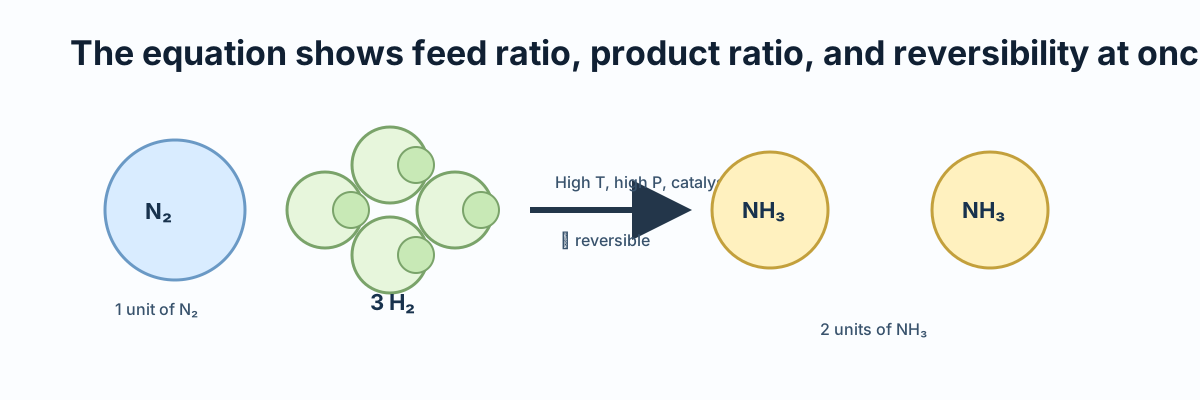
The reaction equation N₂ + 3H₂ ⇌ 2NH₃ can be read in at least three ways: as a required ratio, a product ratio, and as a reversible reaction. Before tackling harder equilibrium equations, make sure you can pick out these three reliably.
- Required ratio: for every 1 of N₂, 3 of H₂ are needed.
- Product ratio: from 1 of N₂, 2 of NH₃ are produced.
- Reversibility: there is not only the forward direction that makes NH₃, but also the reverse direction back to the reactants.
To find the limiting reagent, "work backward from the side you want to fully use up"
When you get stuck on a stoichiometry problem, first look at how many times more of the other reactant you need to fully consume one side. For example, if you have 2 mol of N₂, you need 6 mol of H₂. If the actual H₂ is less than that, H₂ is the limiting reagent.
Instead of memorizing the coefficient ratio, be able to say in a sentence: "to use up all the N₂, you need three times as much H₂". That makes later equipment design much less error-prone.
Check your understanding
Practice 6–8
Read the 1 : 3 : 2 coefficients as required amounts, produced amounts, and limiting reagent.
Q6. From the reaction N₂ + 3H₂ ⇌ 2NH₃, how many mol of H₂ are required per 1 mol of N₂?
Q7. You have 4 mol of N₂ and 12 mol of H₂. If the two react completely at the exact stoichiometric ratio, how many mol of NH₃ are produced at most?
Q8. With 2 mol of N₂ and 3 mol of H₂, which runs out first?
At the same temperature and pressure, you can also read volume ratios
When comparing gases at the same temperature and pressure, mole ratios and volume ratios behave the same way. Therefore, for every 1 L of N₂, you need 3 L of H₂. This is the intuition behind looking at ratios first when sizing inlet flows.
What it means to pull NH₃ out of the mixture outside the reactor
Because this reaction is reversible, letting NH₃ accumulate in the system makes it harder to keep driving the forward direction. So after the reaction, the mixture is cooled and NH₃ is separated out, and the unreacted gas is sent back. That raises the overall utilization of the loop.
This is where the reaction equation finally connects to the equipment. Do not try to finish everything at 100% inside the reactor — separate the product outside and feed the rest back. That is the engineering mindset.
Check your understanding
Practice 9–11
Check volume ratios, reversibility, and the meaning of separating NH₃.