Understand the Haber–Bosch Process with Diagrams and Exercises
An introductory course that walks through how atmospheric nitrogen is converted to ammonia — reaction equation, stoichiometry, temperature and pressure, catalyst, recycle loop, and green ammonia — with diagrams and short exercises.
Diagram → stoichiometry → conditions → loop → simulator
Read atmospheric nitrogen from both the equipment side and the reaction side
In this course, instead of just staring at chemical equations, you will understand why high temperature, high pressure, a catalyst, and recycle are all needed as one connected picture. Because you grasp the role of each piece of equipment and the mole ratios first, you do not stop at memorizing the reaction equation.
0 / 36 correct. Your progress is stored only in this browser's localStorage.
This page is readable without JavaScript, but the simulator and grading will not work.
The first intuition we want to build in this course
The Haber–Bosch process is an industrial route that takes N₂ — abundant in the air but hard to react — together with separately produced H₂, and converts them into NH₃ at high temperature and high pressure over a catalyst. The important point here is not to read the reaction equation alone, but also what happens outside the reactor.
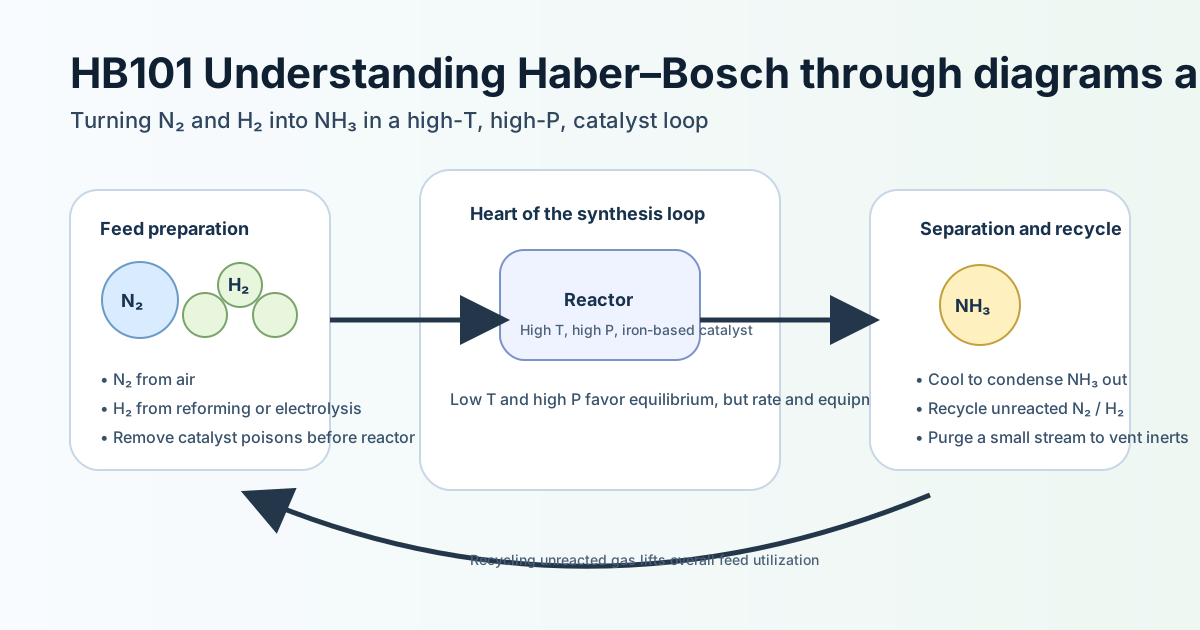
Inside the reactor, the reaction is simply N₂ + 3H₂ ⇌ 2NH₃. In the real plant, however, there is feed preparation and purification upstream, and cooled separation, recycle, and purge downstream. The fact that not everything reacts in a single pass is what makes the loop design necessary.
Five viewpoints we keep reusing
- See the central reactionRead N₂ + 3H₂ ⇌ 2NH₃ not as rote memorization, but as a "ratio" and a "direction".
- Separate equilibrium from rateLow temperature and high pressure favor the equilibrium, but rate and equipment cost are separate issues.
- Separate what the catalyst doesThe catalyst affects reaction rate. It does not bend the direction of equilibrium.
- Think in terms of the loopDo not look at the reactor alone. Treat it as a single system that includes cooled separation, recycle, and purge.
- Separate upstream from downstreamIn green ammonia, mainly the upstream H₂ supply changes; the downstream synthesis-loop knowledge still applies directly.
Chapter overview
| Chapter 1 / 5 questions | Introduction — why we make ammonia from the air Sort out ties to food, chemicals, and energy; why N₂ is hard to handle; the division of roles between Haber and Bosch; and an entry point to green ammonia. |
|---|---|
| Chapter 2 / 6 questions | Reaction and stoichiometry — reading N₂ + 3H₂ ⇌ 2NH₃ by hand Lock in the 1:3:2 ratio, reversibility, the limiting reagent, and the meaning of pulling NH₃ out of the mixture. |
| Chapter 3 / 5 questions | Temperature, pressure, and equilibrium — low-T, high-P is favored, but that alone is not enough Cover the exothermic forward reaction, the drop in total moles of gas, the trade-off between low-T advantage and slower rate, and the benefits and costs of higher pressure. |
| Chapter 4 / 5 questions | Catalyst and rate — why iron is the workhorse and why impurities are a problem Work through the activation barrier, iron-based catalysts, promoters, where Ru-based systems sit, and the difference between impurities and inerts. |
| Chapter 5 / 4 questions | Process loop — compression, reaction, cooling, separation, recycle, purge Lock in feed preparation, compression, the reactor, condensation/separation, recycle, purge, and how the upstream changes for green ammonia. |
| Chapter 6 / 4 questions | Simulator and minimal model — move the conditions and turn them into intuition Read the educational toy model and its vanilla JavaScript implementation, and follow by hand how condition changes turn into intuition. |
| Chapter 7 / 7 questions | Final review and full question list — explain the mechanism as one loop Shows 7 case questions and review links for all 36 questions. |
Tips for studying
- Read the body text, then solve the exercise right below it. That sticks better than reading alone.
- On stoichiometry problems, do not skip to the answer in your head — write out the
1 : 3 : 2ratio on paper once. - The biggest trick is not to mix up "favored at equilibrium" in Chapter 3 with "goes faster" in Chapter 4.
- The Chapter 6 simulator is a combined model that ties together the conditions covered in Chapters 3–5 (temperature, pressure, catalyst activity, purge rate). Reading through Chapter 5 first and then opening the simulator lets you read each metric directly with the wording from the chapter text.
Prerequisites
- Some familiarity with high-school chemistry reaction equations and mole ratios is enough.
- We do not go into rigorous derivations of reaction kinetics or catalyst surface science. The priority is to first grasp the skeleton of the equipment and the reaction.
- The simulator in this course is an educational simplified model and is not a real plant design value.
Goal of this course
- State the central reaction and the stoichiometric ratio of the Haber–Bosch process.
- Explain what low temperature, high pressure, the catalyst, and recycle each affect.
- Distinguish catalyst poisoning from inert-gas buildup.
- Separate what changes in the upstream for green ammonia from what stays the same in the downstream.