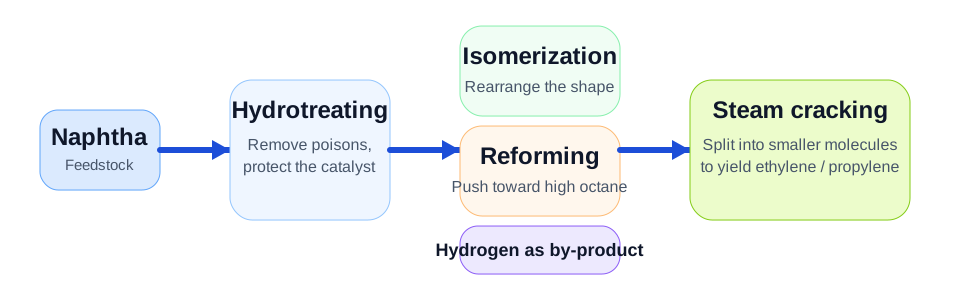
Reactions and uses — hydrotreating, isomerization, reforming, steam cracking
Instead of memorising unit names, distinguish the four processes by what reaction each one actually performs.
Entry point: high-school chemistry equations and mole ratios
Terms to know before this page
Pretreatment
A step that removes troublesome components before the main reaction.
Catalyst
A material that helps a reaction proceed. Its activity drops when fouled or poisoned.
Isomerization
Rearranging a molecule's skeleton without changing its molecular formula.
Reforming
A set of reactions that pushes the stream toward higher octane.
Catalytic ("contact" / 接触)
"Catalytic" simply means "using a catalyst." When you see "catalytic reforming" or "catalytic cracking," read it as "the version with a catalyst."
Olefins
Hydrocarbons with a carbon–carbon double bond, such as ethylene and propylene. "Olefin" and "alkene" are used interchangeably — they refer to the same family.
Steam cracking
A high-temperature thermal process that breaks molecules into smaller ones.
Four kinds of downstream operation
Hydrotreating
Remove sulphur, nitrogen, and similar species to protect downstream catalysts.
Isomerization
Keep the molecular formula; rearrange straight chains toward branched.
Reforming
Push heavy naphtha toward higher octane; aromatics and hydrogen are typical products.
Steam cracking
Break molecules at high temperature to yield olefins.
Start by grouping each unit by "what operation is it performing?"
Hydrotreating — remove the troublemakers first
Sending raw naphtha straight into a downstream catalytic unit lets sulphur and nitrogen poison the catalyst. Hydrotreating is placed in front to protect the next stage.
Schematic:R-S-R' + 2 H2 → RH + R'H + H2S
The key point is to read it as a step that removes catalyst poisons before anything else tries to change the character of the stream.
Isomerization — same formula, different shape
Straight-chain C5 / C6 paraffins do not have particularly high octane on their own. Isomerization rearranges the skeleton toward branched forms while the molecular formula stays the same, which improves octane.
Example:n-C6H14 → iso-C6H14
"Same atom count, different connectivity" maps directly onto the structural-isomer intuition you picked up in high school.
Reforming — push heavy naphtha toward higher octane
In reforming, cyclisation, dehydrogenation, and isomerization are combined. The result is reformate and aromatics, with hydrogen as a by-product.
Heavy naphtha — especially the side with a decent share of naphthenes — pairs visibly well with reforming.
Steam cracking — break molecules into smaller pieces
Steam cracking does not rearrange with a catalyst. At high temperature, molecules are broken into smaller pieces to aim for olefins such as ethylene and propylene.
Example:C6H14 → C2H4 + C3H6 + CH4
Real naphtha is a mixture, and in practice many reactions proceed simultaneously. For now, just lock in the view of "the process that breaks molecules into smaller pieces."
Approximate operating conditions
Exact values vary with equipment, catalyst, and feedstock, but holding the order-of-magnitude in your head makes operational documents much easier to read.
Process
Approx. temperature
Pressure / catalyst
Hydrotreating
About 300–400 °C
Under hydrogen pressure. Co–Mo / Ni–Mo sulphide catalysts.
Isomerization (C5/C6)
About 120–250 °C
Hydrogen co-fed. Chlorinated alumina or noble-metal/zeolite catalysts.
Catalytic reforming
About 480–540 °C
Hydrogen co-fed. Pt-based noble-metal catalysts.
Steam cracking
About 750–850 °C
Steam-diluted, very short-residence-time thermal cracking (no catalyst).
The two contrasts worth remembering: "hydrotreating, isomerization, and reforming are catalytic processes that use a catalyst, while steam cracking is a thermal process with none," and "steam cracking sits one order of magnitude higher in temperature than the others."
Self-check
Five questions to distinguish the four processes by the reaction each one performs.
Q 4-1 — Purpose of hydrotreating
What is the main reason hydrotreating is placed as a pretreatment step?
To remove sulphur and nitrogen and protect downstream catalysts.
To convert every molecule to methane.
To force the liquid to dissolve in water.
Show answer and reasoning
Answer: A
Hydrotreating is pretreatment that removes catalyst poisons ahead of time.
Q 4-2 — Role of isomerization
Which operation typically takes straight-chain C5 / C6 molecules and shifts them toward branched forms to raise octane?
Isomerization.
Steam cracking.
Hydrotreating.
Show answer and reasoning
Answer: A
Isomerization keeps the molecular formula constant and only changes the connectivity.
Q 4-3 — What reforming produces
Which operation is representative for taking heavy naphtha and producing reformate, aromatics, and hydrogen?
Catalytic reforming.
Desalting.
Polymerisation.
Show answer and reasoning
Answer: A
Reforming pushes heavy naphtha toward higher octane and also yields hydrogen.
Q 4-4 — The process that targets olefins
Which process primarily targets small olefins such as ethylene and propylene?
Steam cracking.
Isomerization.
Reforming.
Show answer and reasoning
Answer: A
Steam cracking is the process that breaks molecules into smaller ones.
Q 4-5 — A reforming by-product reused on site
Which by-product from reforming is commonly reused elsewhere in the refinery?
Hydrogen.
Nitrogen.
Sodium chloride.
Show answer and reasoning
Answer: A
The hydrogen from reforming is important for hydrotreating and other units.
Chapter 4 summary
Hydrotreating is pretreatment that protects downstream catalysts.
Isomerization keeps the molecular formula constant and rearranges the skeleton.
Reforming pushes heavy naphtha toward higher octane and also yields hydrogen.
Steam cracking breaks molecules into smaller ones to target olefins.