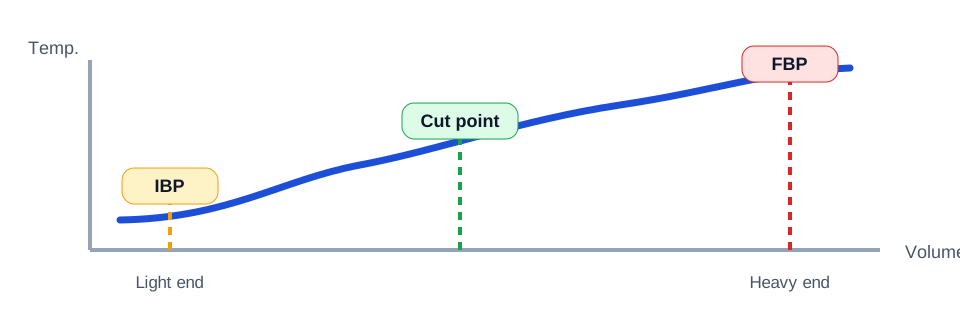
Here you practise reading naphtha not by a single boiling point but by "the range from where it starts boiling to where it finishes boiling."
Entry point: high-school chemistry equations and mole ratios
Terms to know before this page
IBP (initial boiling point)
The temperature at which distillate first starts coming over.
FBP (final boiling point)
The temperature at which the last of the distillate finishes coming over.
Boiling range
The temperature span from where a mixture starts boiling to where it finishes boiling.
Cut
The range, from where to where, that is carved out as a product.
Light naphtha
Naphtha on the light side, with more C5 / C6.
Heavy naphtha
Naphtha on the heavier side, with more C7 and above.
In distillation, read the "range"
Because naphtha is a mixture, we look at the range from IBP to FBP in distillation — a single temperature cannot describe it.
Raising the IBP (initial boiling point) = excluding low-boiling components from the cut. Raising the FBP (final boiling point) = pulling more of the high-boiling components in. Both are "moving the edges of the cut" operations.
"Raising" the IBP means components that would distil below that temperature — the very light, highly volatile, easily flammable components — drop out of the cut. "Raising" the FBP means distillation continues to higher temperatures, pulling more of the heavy side in. In short, IBP is the boundary on the light side and FBP is the boundary on the heavy side.
For this course, reading "which way does it move?" is enough. Rigorous equipment conditions belong in operational documents.
Shape of the distillation curve — plateaus and tailing
Real distillation curves (volume distilled on the x-axis, temperature on the y-axis) do not always rise smoothly. Two shapes show up often:
Plateau
A near-flat segment of the curve at one temperature band, indicating components clustered around that temperature.
Tailing
A late, steep rise — or a "drawn-out tail" — indicating a small amount of high-boiling material still left on the heavy end.
This course does not dig deeper, but knowing "the shape itself carries hints about composition" prevents confusion when you finally see real distillation data.
Light naphtha and heavy naphtha
Rather than treating full-range naphtha as a single thing, splitting into a light side and a heavy side makes the downstream fit much clearer.
A handy mnemonic: light = evaporates easily; heavy = pairs well with reforming.
What changes as you move the cut
Pulling the cut toward the light side drops the average carbon number and raises volatility. Pulling it toward the heavy side does the opposite — average carbon number rises and volatility drops.
Shift toward the light side
Average carbon number drops; it evaporates more readily.
Shift toward the heavy side
Average carbon number rises; it evaporates less readily.
Even this single change significantly reshapes which downstream process the stream fits.
"Same naphtha" is never fixed
The name "naphtha" alone does not pin down the actual stream. Which crude, which cut, what pretreatment — any of those can shift the boiling range and composition.
That is why, in design and procurement, boiling range, composition, SDS, and analytical data come before the name.
Self-check
Five questions to check how you read IBP / FBP and light / heavy.
Q 3-1 — What IBP / FBP mean
What do the initial boiling point (IBP) and final boiling point (FBP) represent?
The start and end temperatures of the distillation range.
Sulphur and nitrogen content.
Research octane number and motor octane number.
Show answer and reasoning
Answer: A
IBP is the temperature where distillation starts; FBP is where it finishes.
Q 3-2 — Average carbon number on the light side
If you shift the cut toward the light side, what happens to the average carbon number?
It tends to drop.
It tends to rise.
It does not change.
Show answer and reasoning
Answer: A
Because you keep more of the light components, the average carbon number drops.
Q 3-3 — Which side goes to reforming
Which of these is most naturally fed to reforming?
Heavy naphtha.
Extremely light naphtha.
LPG.
Show answer and reasoning
Answer: A
Heavy naphtha is the natural feedstock for reforming.
Q 3-4 — Volatility when extending to the heavy side
Keeping composition constant, what happens to relative volatility if you pull more of the heavy side into the cut?
It rises.
It falls.
It does not change.
Show answer and reasoning
Answer: B
More heavy components generally means lower volatility.
Q 3-5 — Why "same naphtha" is not fixed
Which statement correctly explains why actual naphtha streams differ even with the same name?
Because the feed crude and the cut range can change.
Because the molecular formula is fixed worldwide.
Because ambient temperature alone decides everything.
Show answer and reasoning
Answer: A
Change the crude and the cut, and composition and properties move with them.
Chapter 3 summary
Read naphtha as a boiling range from IBP to FBP, not a single temperature.
Shifting toward the light side drops the average carbon number and raises volatility.