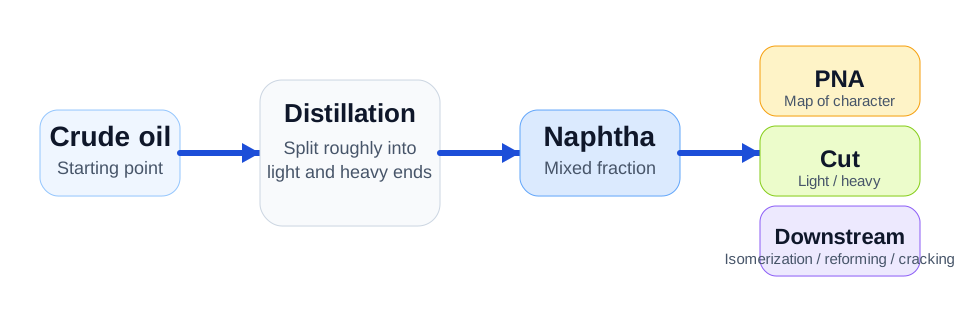
The first goal is to stop seeing naphtha as "just another hexane-like compound" and start seeing it as a range of mixed hydrocarbon liquid.
Entry point: high-school chemistry equations and mole ratios
Terms to know before this page
Pure compound
A substance that can be captured by a single kind of molecule, such as hexane.
Fraction
A range of components with similar boiling points, cut out together by distillation.
Hydrocarbon
A molecule made mainly of carbon (C) and hydrogen (H).
Gasoline
A spec-controlled fuel blend sold as a final product.
The short answer
Naphtha is a relatively light liquid-side fraction distilled out of crude oil and related feeds.
Unlike "hexane" or "toluene," where one name points to one molecule, "naphtha" points to "a grouping of liquid around this kind of weight."
The feel you want up front: naphtha is not a single compound name but a range of liquid carved out by distillation.
Where naphtha sits on the distillation ladder
Roughly speaking, naphtha is the liquid fraction a bit heavier than LPG and lighter than kerosene. What matters here is not a precise temperature — it is the positioning as "the relatively light liquid side."
Where it sits
How to read it
Light gases / LPG
Even lighter than naphtha. Tends toward the gas side.
Naphtha
Often described as centred around C5–C12, on the lighter liquid side.
Kerosene / gas oil
The liquid fractions heavier than naphtha.
That is why phrases like "relatively light liquid fraction" fit naphtha so well.
Not the same word as gasoline
Gasoline is the name of a finished product. Naphtha, on the other hand, is used for the feedstock / fraction side that sits upstream of it.
In refinery contexts, you see it in phrases such as "send the light naphtha to isomerization" or "send the heavy naphtha to reforming" — it is vocabulary for deciding which downstream unit to feed.
Why two "naphthas" can still be different
Naphtha is a mixture, so two streams with the same name are not identical. Three things change its character.
Different crudes
The kind of crude you feed shifts which molecular families show up.
Different cuts
How far into the light end you go, and how far into the heavy end you extend, changes the weight.
Different pretreatment
Whether it has been hydrotreated, or came from a cracker, changes the composition.
That is why operations never assume "naphtha means X" — they check the SDS and analytical data.
Self-check
Five questions to nail down the "fraction, not pure compound" entry point.
Q 1-1 — The most straightforward way to describe naphtha
Which description best matches naphtha?
A relatively light mixed hydrocarbon fraction obtained from crude oil and related feeds.
Another name for a single C6 compound.
The official name for finished automotive gasoline.
Show answer and reasoning
Answer: A
Naphtha is not one molecule; it is a mixed fraction on the light-liquid side.
Q 1-2 — Relationship to gasoline
Which statement about naphtha and gasoline is correct?
They are fully synonymous and always interchangeable.
Gasoline is the final-product name; naphtha is usually used for the upstream fraction / feedstock.
Gasoline is a single molecule, while naphtha is a generic term for polymers.
Show answer and reasoning
Answer: B
Gasoline is a spec-controlled fuel; naphtha is the upstream fraction or feedstock.
Q 1-3 — Why one formula does not capture it
Why is it difficult to write a single molecular formula for naphtha?
Because it is a mixture of many hydrocarbons.
Because it contains no carbon at all.
Because it always dissolves completely in water.
Show answer and reasoning
Answer: A
As a mixture, it cannot be written down as one formula the way hexane can.
Q 1-4 — Lightness relative to kerosene
In atmospheric distillation, which side does naphtha fall on compared to kerosene?
The lighter side.
About the same.
The heavier side.
Show answer and reasoning
Answer: A
Naphtha is the lighter liquid fraction above kerosene.
Q 1-5 — Why "naphthas" differ from refinery to refinery
Why does the actual character of "naphtha" differ from place to place even when the name is the same?
Because the type of crude and the cut range change.
Because its molecular formula is fixed worldwide.
Because only the colour of the storage tank decides everything.
Show answer and reasoning
Answer: A
Change the crude, the cut, or the pretreatment and the contents and properties move with them.
Chapter 1 summary
Naphtha is not the name of one compound — it is a relatively light mixed hydrocarbon fraction.
Gasoline is a final-product name; naphtha is a fraction / feedstock name.
Same name, different character: crude, cut, and pretreatment all shift what is actually in the stream.